In April 2025, I gave a research lecture at Falmouth University on the subject ‘Good Grief – Literary Techniques for the Navigation of Trauma in Poetry and Song’.
It identified typical techniques used by writers to address complicated grief and ultimately move beyond it.
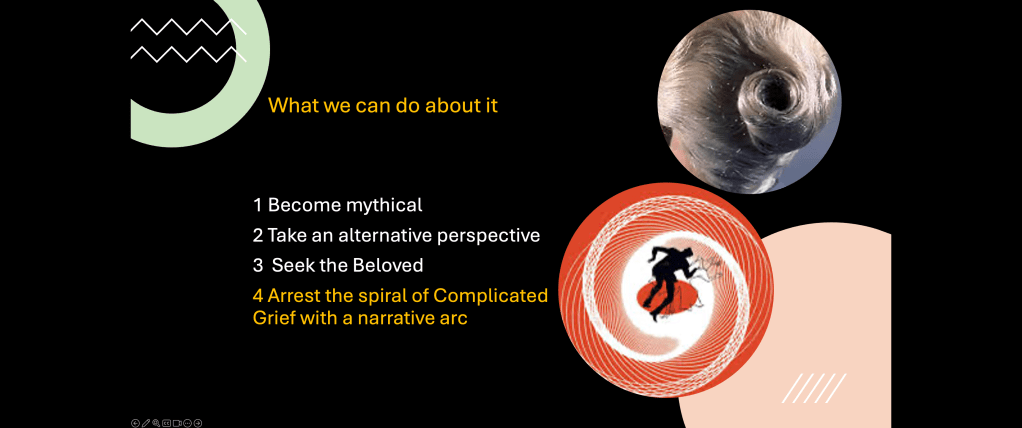
The lecture was only the beginning, and I realised I wanted to study the subject further. Later in the year, I ran an online ‘studio’ course with the Poetry School which ran to four weeks and welcomed writing responses in the form of poetry and song.
Here is the course summary:
In Levels of Life, Julian Barnes claims that grief – like sex and parenthood – separates those who have experienced it from those who have not. Complicated grief, whether related to a change of environment, a bereavement, the end of a relationship, or traumatic event that is hard to process, can leave a person in a position in which, although the world keeps turning, they are trapped at the point of their trauma, endlessly replaying events to no positive end. How to break the spiral?
With reference to the work of Nick Cave, Bruce Springsteen, David Berman, Jack Gilbert, Mimi Khalvati, Alice Hiller, David Tait, Harry Man and Endre Ruset, Paul Stephenson, Carrie Etter, Annie Fisher, Ted Hughes, Maya Abu Al-Hayyat, Charles Schultz, Tove Jansson, Blade Runner and Twin Peaks, we will look at different approaches taken by poets and songwriters to regain agency – including thinking mythologically, taking our own slant, seeking out the missing directly and creating our own narrative arc.
We will write list poems (with a twist), epistolary poems and ‘live photos’, as well as experimenting with altering syntax, tense, and vantage to approach our grief from different angles – and push language’s ability to shape and contain reality to its limits. We will see how harnessing our personal stories to those that have come before allows us to place our experience in the larger human context, no matter how devastating. We will look at what is left behind in the absence of a loved one – or a present or future we had thought secure – as well as what we are able to do with it. We will consider the demands of public-facing and private-facing grief and how, in the words of songwriter Julie Byrne, ‘Grief is more than sorrow, it’s collaboration.’
Can the act of writing replace a spiral with a narrative arc? Can writing about grief provide an agency lacking in life? Can, as Nick Cave claims, grief result in you becoming a more total human being?
As with my Lost and Found project, there were two visual touchstones for the course: the figure Ninny, from Tove Jansson’s Moomin books, and a cartoon from Australian cartoonist Michael Leunig titled ‘”Gee Dad, you’re fantastic!” to which I was introduced by Nick Cave.
I will be running a four-week in person course at the Phoenix Arts Centre in Exeter in September 2026.
 Matt Bryden Poetry